Gardner farm blight
The Colour Out of SpaceThe Gardner farm blight is the spreading corruption of the farm after the meteorite’s fall: a process that alters crops, vegetation, livestock, water, and the household before leaving a barren tract that remains anomalous years later. Its importance lies in how it unfolds by degrees. Each new change is first mistaken for a local problem, then accumulates into evidence that the land itself has become hostile to ordinary life.
First Signs and Local Explanations
The blight first became apparent in the farm’s produce. Pears and apples grew unusually large, glossy, and abundant, prompting Nahum Gardner to order extra barrels, but the fruit proved inedible, with a bitter, sickening quality. Melons and tomatoes suffered the same fate, and Nahum Gardner concluded that the meteorite had poisoned the soil. He took some comfort in the fact that most other crops grew on higher ground, away from the house.
In early March, the abnormality reached the plants beside the road. Skunk-cabbages emerged through the mud in unprecedented sizes and unfamiliar colours, with shapes and an odour that unsettled those who came to look. People linked them to the ruined fruit and repeated the belief that poison lay in the ground. The plants did not provide a clear explanation, however: what people could observe was striking, but they had no means of identifying what had entered the soil or how it acted.
By April, the change had spread across the garden and nearby pasture. Orchard trees blossomed in strange colours, and unfamiliar growth appeared among the local flora. Nahum Gardner continued to plough and sow the ten-acre pasture and the upland lot, but left the land around the house untilled, hoping the season’s growth might draw the poison out. The colours seemed to recall the meteorite’s brittle globule, tying the altered landscape to the original fall even as the farm’s familiar vegetation became harder to distinguish from the new growth.
A Landscape in Decline
The corruption moved beyond abnormal colour and form. A newspaper account described a dim luminosity in the grass, leaves, and blossoms around the farm, and a detached patch of light apparently moving near the barn. Toward the end of May, the cows’ milk became bad; after Nahum Gardner moved the animals to the uplands, the problem ceased. The apparent improvement was temporary and local. The grass and leaves near the house turned grey and brittle, while the family’s physical and mental condition also worsened.
By the time the plants began greying, the farm had become increasingly isolated. Ammi Pierce was the only person who continued to visit, and those visits grew less frequent. When school closed, the Gardner family was virtually cut off from the wider community and sometimes relied on Ammi Pierce to run errands in town. The plants’ changes were therefore not simply a strange agricultural loss: they coincided with a shrinking of the family’s everyday contact with other people and with the increasing difficulty of living on the property.
In September, the deterioration was broad and rapid. Vegetation crumbled toward grey powder; fruit was stunted, grey, and tasteless; and flowers that had once shown unfamiliar colours became distorted and grey. The insects that had become unusually abundant also died. These recurring transformations mark the blight’s progression from altered growth to the collapse of the farm’s living systems. The landscape did not recover when one crop or species failed; successive forms of life were affected in turn.
Water, Livestock, and Household Consequences
The farm’s water supply became another part of the decline. Ammi Pierce found that the well water had acquired an abnormal taste and advised Nahum Gardner to dig a replacement well on higher ground. Nahum Gardner ignored the advice. He and his sons continued to drink from the existing well, while the family’s meals and daily work grew increasingly meagre and mechanical. The source of the water’s alteration was not established at the time, but its condition connected the blight to a resource the household could not easily do without.
The livestock also succumbed, including animals that had not been fed on the affected vegetation. Poultry died, and the hogs and cows underwent unexplained changes before dying; a city veterinarian from Arkham was baffled. By harvest time, none of the farm’s animals remained. The dogs had disappeared, and the cats had already left. The sequence weakened an ordinary explanation based only on poisoned fodder: the effects extended to animals in the barn, and the evidence offered no clear route by which the condition had reached them.
The household’s decline unfolded alongside these environmental changes. Nabby Gardner and Thaddeus Gardner became seriously unwell and were kept in separate attic rooms; the family’s younger members were frightened and increasingly withdrawn. Thaddeus Gardner later died in his room. The evidence presents these events as part of the same expanding affliction, while leaving its precise action on people unexplained. The family’s losses and isolation thus parallel the farm’s ecological collapse without reducing the blight to a single, identifiable illness.
The Blighted Heath and Unresolved Persistence
After the deaths of Nahum Gardner and Nabby Gardner and the disappearance of Merwin Gardner and Zenas Gardner, investigators returned to the farm. The remains they found were so reduced that the medical examiner had little to examine. Dust samples taken from the site produced an unknown spectrum under analysis, with bands resembling those recorded from the meteorite. That spectral property disappeared within a month; afterward, the dust consisted mainly of alkaline phosphates and carbonates. The brief recurrence of the meteorite’s anomalous signature offered a scientific clue, but not a lasting explanation.
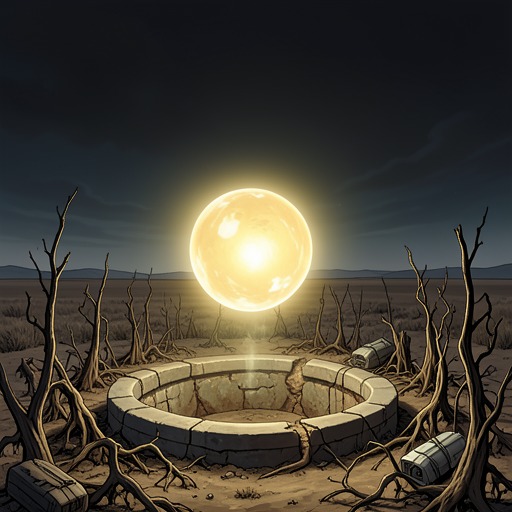
The property did not return to normal. On a later visit, observers found no substantial ruins beyond the chimney bricks, cellar stones, scattered mineral and metallic matter, and the rim of the well. Five acres remained a dusty grey tract where nothing grew, known locally as the Blasted Heath. Reports held that the blight might be spreading by small increments, perhaps an inch each year. Other accounts described abnormal spring colour in nearby vegetation, unusual tracks in winter snow, skittish horses, and hunting dogs that could not be trusted near the grey ground. These later reports are presented as local testimony rather than settled scientific findings, but they suggest that the damaged area continued to shape the surrounding countryside.
The narrator’s account likewise distinguishes observation from inference. The abandoned well and its water remain suspect, and the possibility that another meteorite globule survived is proposed rather than proved. The narrator speculates that whatever remains may be confined or nourished by something in the landscape, but cannot determine its nature. This uncertainty is central to the blight’s significance: the farm’s destruction is visible, its effects recur in testimony and traces, yet neither laboratory analysis nor local explanation can place the phenomenon within familiar natural laws. The slow sequence of damaged crops, altered habitats, failing animals, and a persistent barren patch makes environmental change itself the story’s accumulating evidence of an incomprehensible force.